

Photo of a chocolate bicolour Ragdoll cat by Nguyen, Pixabay
It’s a safe bet that almost everyone reading this blog has seen the famous cover of ‘Time’ magazine featuring Taylor Swift with her Ragdoll cat Benjamin Buttons relaxing across her shoulders like a shawl. That cat definitely knows how to pose (and yes, I am talking about Benjamin!)
It’s no fluke that the shot was set up with a Ragdoll cat. They are calm – so calm that they relax when picked up. Some relax so much that they flop in your arms like a rag doll. They love human company and follow their people around the house just to be near them. The general advice is to keep purebred Ragdolls either indoors or in a secure outdoor run, as they are not naturally streetwise fighters and are so placid that they are unlikely to struggle if they are picked up to be stolen.
The Origin of the Breed
That calm and relaxed nature was the primary aim of the first Ragdoll breeder – Ann Baker of California. In 1963, Ms Baker noticed a local stray with a placid and loving temperament and adopted her, calling her ‘Josephine’. Josephine’s litters from that time onwards were fathered by Ms Baker’s pure-bred Birman and Persian cats and her kittens had the seal-point markings and blue eyes characteristic of those breeds, with Josephine’s long, thick white fur as a background. These were the first Ragdoll kittens.
Ms Baker was fiercely protective of her Ragdolls. In 1971, she took the unusual step of trademarking the name ‘Ragdoll’ in order to set up her own breed regulator, the International Ragdoll Cat Association. The standards she set were so strict that a group of Ragdoll breeders broke ranks in 1975 and applied to the traditional cat registries for breed recognition for their own litters.
The Standard
The Federation Internationale de Feline (FIFe) sets the standards for cat breeds in Europe. They define a Ragdoll as a medium to large cat with a muscular body, broad wedge-shaped head, medium-long fur and a long fluffy tail. Their fur is cream or white with one darker colour to the tail, ears, face and sometimes legs. The dark fur presents in one of three different colour marking patterns;
- Colourpoint – Solid ‘mask’ to the face and ears
- Bicolour – Has a white triangle bisecting the face mask and a ‘saddle’ of darker fur (Benjamin Button is a bicolour)
- Mitted – Legs are darker apart from distinct pale ‘mittens’ on the front paws and short white ‘boots’ on the back paws. White stripe runs from under the chin and all along the belly to the tail.
The accepted colours for the darker markings are;
- Seal – a deep, rich, dark brown
- Blue – a blue-grey colour like slate
- Chocolate – a warm brown, not as dark as Seal
- Lilac – a grey paler than Blue, with a pink tint to it
- Red – pale orange
- Cream – the colour of double cream
Above all – those eyes. Brilliant blue eyes, wide and rounded.
Cool fact!
Here’s a fun fact about the darker fur on a Ragdoll; it’s caused by a genetic marker in the fur that is temperature sensitive. That darker fur grows on the cooler parts of the body. When the FIFe standards describe the Ragdoll’s fur as feeling like ‘cold silk’, I doubt they were thinking of just the paler fur.
If you do adopt a Ragdoll, be aware that not every cat will flop dramatically when picked up; the ‘calm and relaxed’ description is a general breed trait rather than a guarantee. The only thing that is guaranteed is that you will need to keep to a regular grooming routine. That luxurious long coat needs to be brushed at least twice a week to keep it unmatted and gorgeous. And of course, you can be pretty sure that people will love the sight of your Ragdoll’s amazing blue eyes and their soft coat.
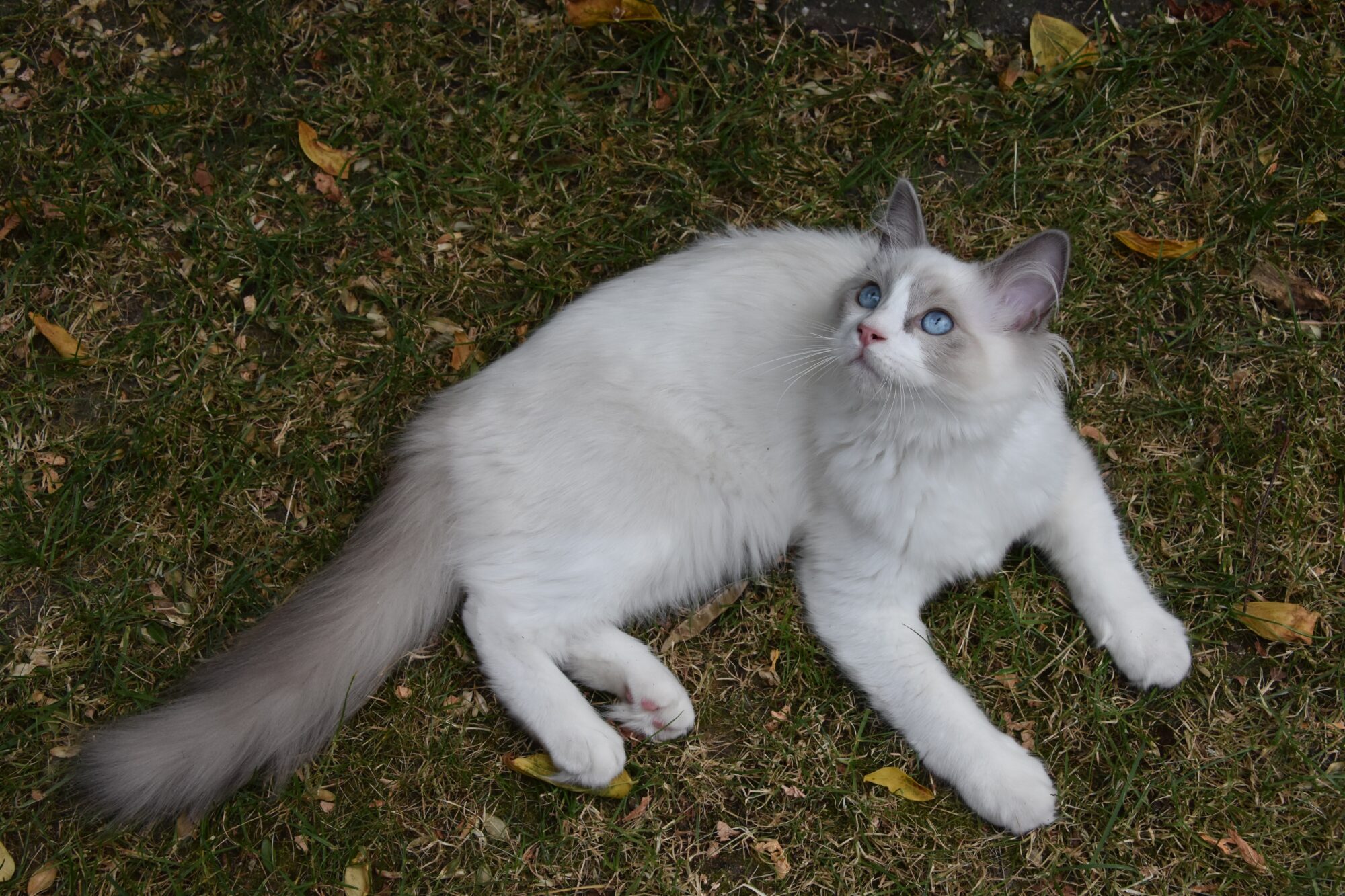
Lilac bicolour ragdoll. Photo by Blue Heaven, Pixabay
