
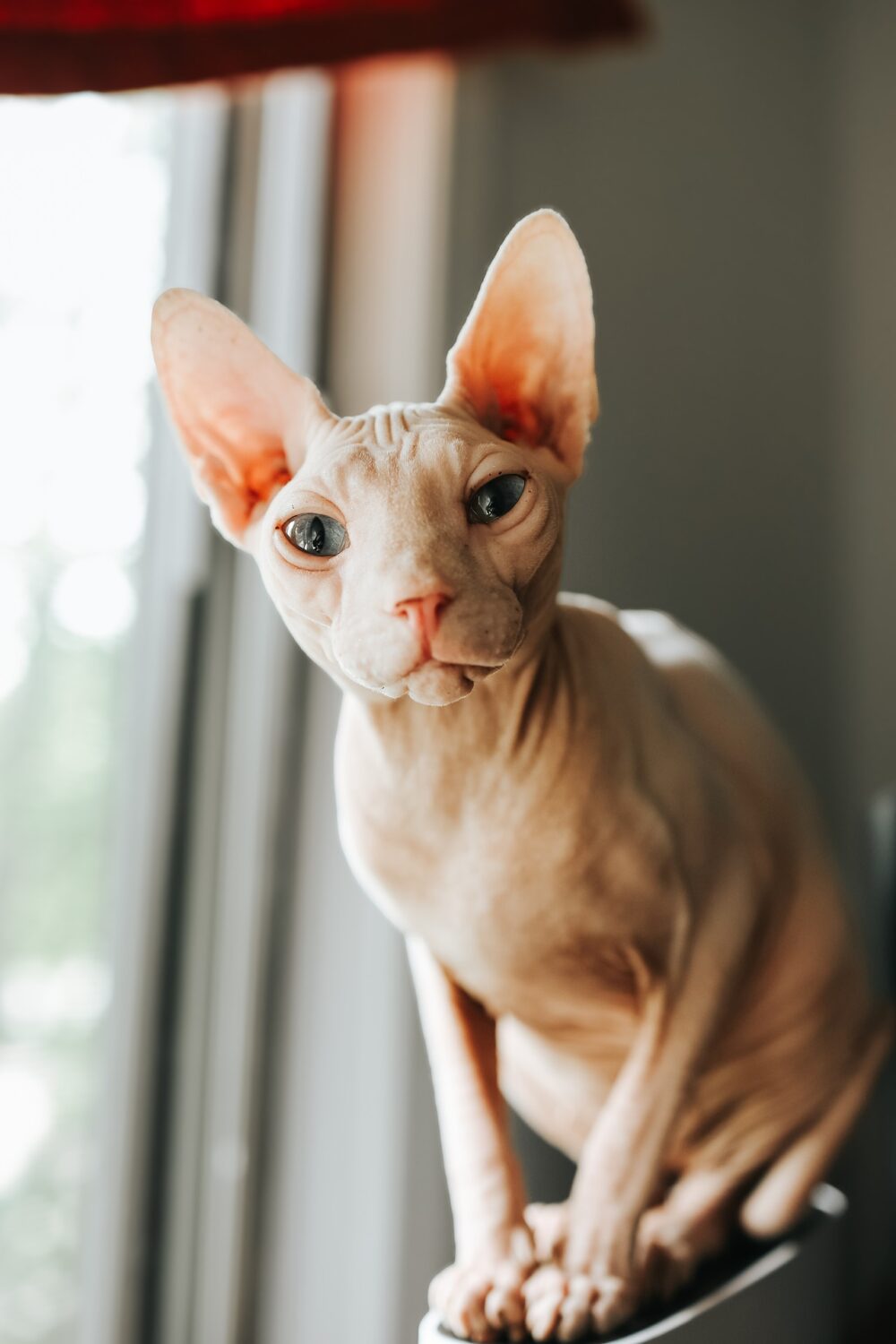
I’ve spent so much time describing the different kinds of fur on various breeds of cat this year that this may be a shock. No fur on this month’s cat – it’s a Sphynx.
The main characteristic of a Sphynx cat is that it is hairless. They do have the same markings as any other cat – black and white patches, calico or all-over black or white – but the colours are marked on the skin like splotches of paint. With big, wide-set eyes and wrinkled skin, Sphynxes resemble E.T. from the Spielberg film. Some people think they’re ugly, but any Sphynx guardian will choose their hairless honey over any fluffy kitten.
The gene that causes hairlessness occurs naturally in the wild, but very rarely. All of the pure-bred Sphynx cats alive today are descended from six hairless kittens whose parents had ordinary fur;
– Prune, born to a domestic short-haired cat in Toronto in 1966
– Dermis and Epidermis, a pair of barn-cats born in Minnesota in 1975 and
– Bambi, Punkie and Paloma, three stray kittens adopted by a Toronto cat breeder in 1978.
DNA analysis in 2010 revealed that the lack of hair is a result of a gene that damages hair strength, meaning that any fur is weakly anchored and quickly shed. Some Sphynx don’t even have whiskers. Stroke a Sphynx and feel their skin – strong and smooth like chamois leather, with perhaps a very short fuzz like a peach.
The cat association with authority over European cat-shows – the Federation Internationale Feline – sets out the standard for the perfect Sphynx.
- The head is wedge-shaped with prominent cheekbones and large ears.
- Eyes must be large, lemon-shaped and wide-set, slanting down towards the nose.
- Body is muscular and sturdy with a barrel chest and a small pot-belly.
- Paws are long and slender with large puffy pads like ‘air cushions’.
- Tail is thin and tapering; it may have a tuft of hair at the tip, like a lion’s tail.
- A quarter of the marks at a cat show are awarded for the quality, texture and wrinkles of the Sphynx’s skin, provided the wrinkles do not impair the cat’s normal activity.
That magnificent wrinkly skin is directly exposed to sunlight. This is a cat that can’t spend much time outdoors without shade or sunblock all over. As well as being vulnerable to skin cancer, the lack of hair leaves them open to getting dirt and debris in their ears and between their toes. Sphynx guardians are advised to check their cat’s ears and paws regularly and clean out any debris and dirt with a moistened cotton wool pad.
At first sight, you’d be forgiven for thinking that this is a cat ideally suited to those allergic to cats. Sadly, not true. As I explained in the Devon and Cornish Rex blog, the allergy to cats is triggered not by their fur but by their skin dander – and as that skin is fully exposed, any skin flakes are free to float. Guardians are advised not to bathe the Sphynx too often; a weekly wipe over with warm water should be enough to clean off excess skin flakes and oil.
Above all, the Sphynx is known for its temperament. Intelligent, active and loyal to its humans, this is a cat that enjoys snuggling with its people. The Sphynx owners I have known are equally devoted to their Sphynxes.
