
One tiny cat with a hugely grumpy expression took over the news this week when it was announced to be a member of the first new cat species declared since 1923. If you missed it, look up ‘Leopardus tilcayo’ and treat yourself to a moment of cat adoration.
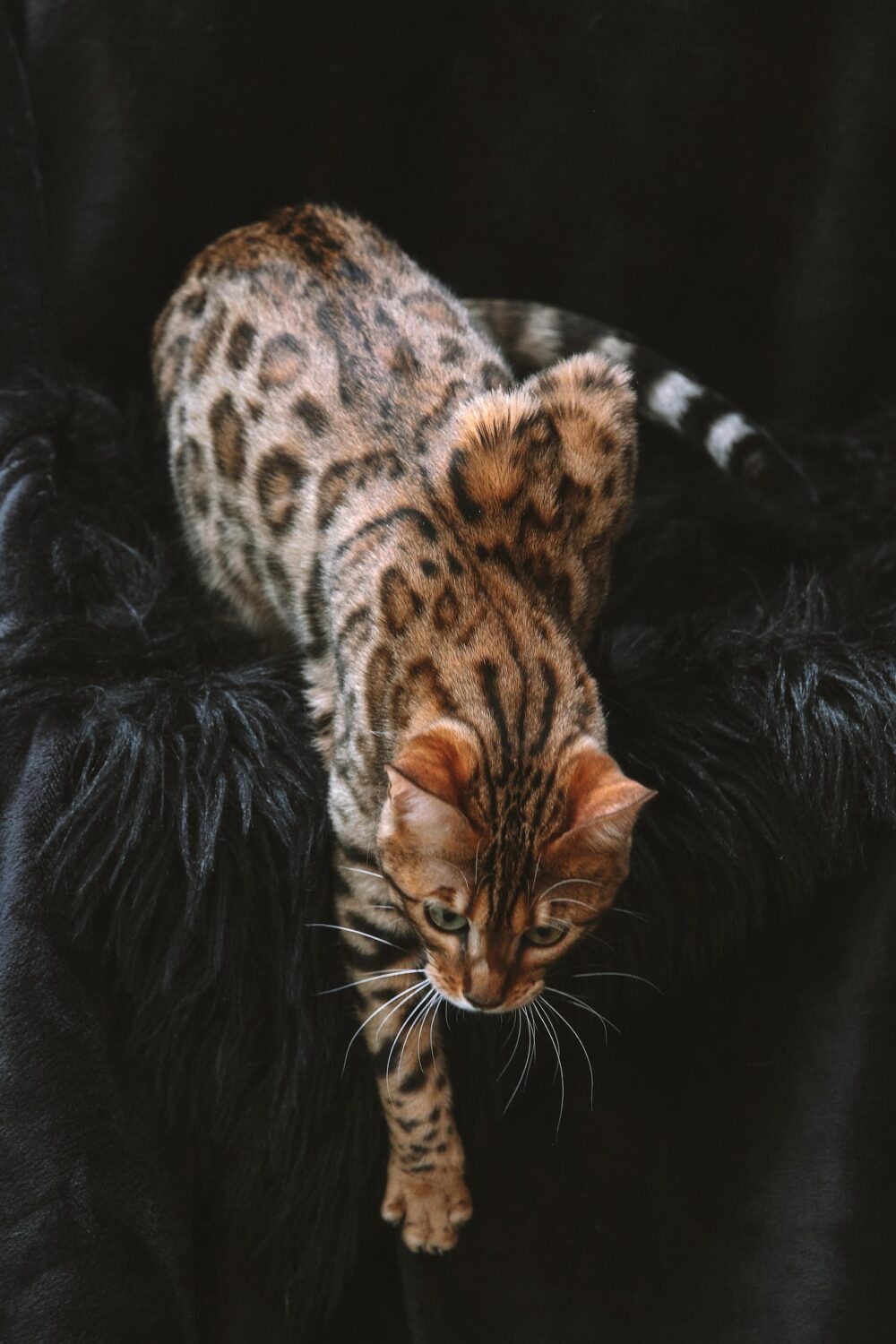
I will leave the news channels to tell the story of this miniature feline. If you’d love to have a Tilcayo as a pet, the nearest equivalent you could safely invite into your home is the Bengal cat. The Bengal is also related to a leopard species – the Asian leopard cat (Prionailurus bengalensis). Like the Tilcayo, Bengals have a fur pattern of darker ‘rosettes’ or random ‘marbling’ against a pale coat background.
Origins
Harrison William Weir, an early cat enthusiast, described a cat born of a cross between a domestic cat and an Asian leopard cat in 1889. But it wasn’t until 1961 that Jean Mill, an American cat breeder, brought a female Asian leopard cat to California and mated it with a black domestic short-haired cat. It’s difficult for anyone under the age of fifty to believe, but until 1976 anyone in the UK could buy a wild animal such as a leopard or a lion, and keep it as a family pet.
It was a long haul between that first hybrid kitten and acceptance of Bengals as a separate breed. Part of the problem was that some of the cats in the first generations kept the instincts of their undomesticated ancestors, playing too rough for anyone accustomed to placid house cats and becoming aggressive whenever a cat show judge handled it for more than a minute.
Success!
Mrs Mill renewed her attempt to breed a miniature domestic leopard in 1975, when Dr Willard Centerwall gave her the group of hybrid Bengal cats he had bred for his research into feline leukaemia. She cross-bred these cats with Egyptian Mau and Abyssinians, took them to cat shows to demonstrate their sweet temperaments and by the 1990’s the Bengal breed was accepted by all the major registries. However, any Bengal cat arriving in Britain needs to prove that both parents and at least one grandparent were domestic cats, and cat shows insist that any competing cat must be able to prove at least two fully domestic generations if not more.
Standards for showing
There are two coat types for a Bengal; spotted (the same large, dark distinct rosette markings as a leopard) and marbled (dark ripples running horizontally in a random pattern). Both must have a spotty belly if they want to impress the judges. The breed standard emphasizes that the Bengal is a sturdy, muscular cat of medium to large size with a friendly, alert nature but allows any eye colour and any fur colour.
Bengals are not just sturdy and alert – they are lively, playful and energetic. Expect major zooming with a chattered commentary to match! You will need to give them the means to run off all that energy – a large safe space, an intricate maze of cat-runs or a feline exercise wheel. They are not generally as affectionate as Sphynx and Ragdolls, but they have definitely swapped the jungle for the delights of soft sofas and cat treats.
Exotic or moggy, we welcome every domestic cat. Contact us to arrange their holiday – or leave a review if they enjoyed their stay!
