
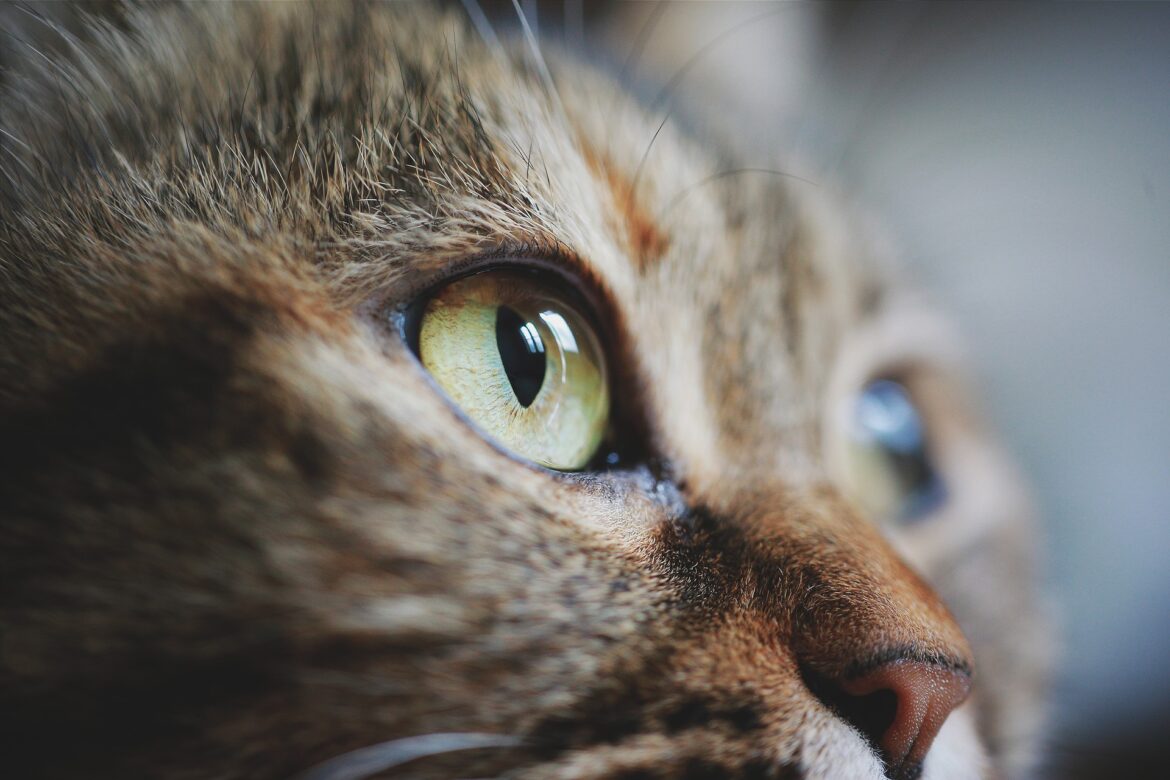
I’m sure you spend a lot of time looking into your cat’s eyes. It’s the feature that attracts the most attention, after all – you’ll notice that your cat looks at your eyes when it wants your attention. But have you ever thought about what your cat sees when it looks at you?
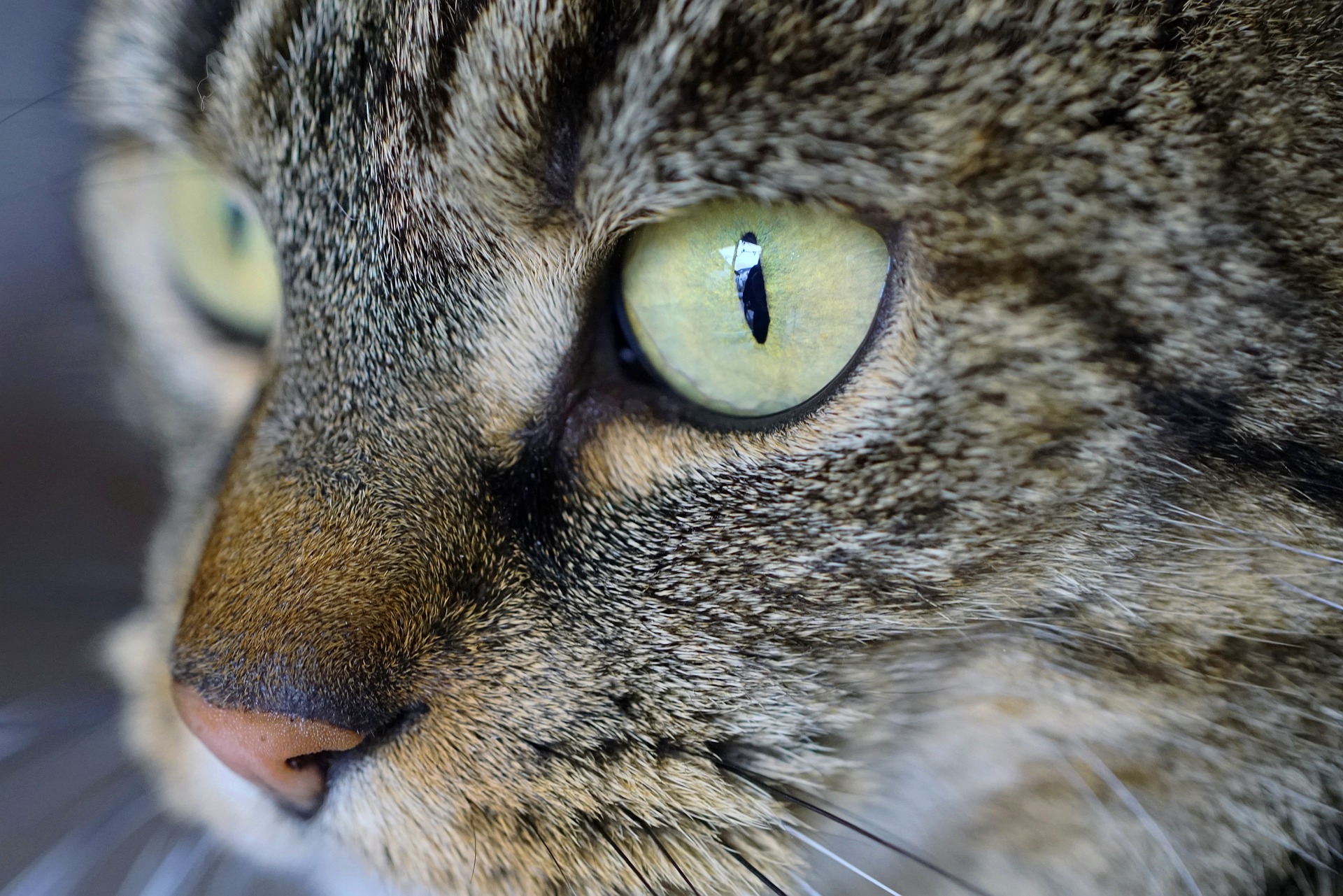
Human eyes and cats’ eyes are almost identical in the way that they work. There are two kinds of light-sensor cells in the eye; one kind looks like a short rod while the other is cone-shaped. The rod-shaped cells are very efficient at gathering small amounts of light, while cone cells identify different colours.
Colour blind
Most humans have the full range of cone cells and can see all the colours of the rainbow, though a few people are ‘colour-blind’ – usually unable to distinguish between blue and green or unable to see red or brown clearly. Cats are all colour blind. They can see blue, grey, yellow and possibly green, though not as distinctly as we can, while reds and browns will be murky non-colours to them. They rely on the red or brown object moving to be able to see it. If you’re buying your cat a toy, choose the blue or yellow one (if it has a catnip centre, even better!)
Night vision
Any optometrist will tell you that humans can see best of all in full daylight and not too badly at night if they take time to let their eyes adjust to the darkness. Human vision is poor in the low and rapidly varying light levels of dusk and dawn. Cats have the advantage over us here. Their eyes adapt to changing light levels very quickly and they have more than twice as many rod cells in their eyes as humans – meaning that they see very clearly at all times. If you have ever had kittens or young cats, you will have noticed that they become playful at dusk and dawn and can have sudden fits of zoomies at night. Just when you want to rest your own eyes, they’re running around the living room singing the song of their people.
When sight fails
Of course, cats have the same ailments as humans, and it is possible for a cat to become completely blind, or to suffer from cataracts that restrict their vision. While we rely mainly on vision to make sense of our world, cats place as much reliance on what they can hear or smell as on what they see. Try opening a can of tuna while your cat is fifty yards away and you’ll get a practical demonstration of their sharp senses. A completely blind cat can navigate their territory very well; scenting where their litter tray is, feeling the warning touch of obstacles through their whiskers and hearing your footsteps to know where you are. If you know or suspect that your cat has trouble with their sight, you should take them to the vet for a check on whether this is a problem that can be treated or just something to be aware of. Make allowances for a partly sighted cat; they won’t react as fast as one with full vision and it’s more likely that they won’t dodge fast enough to avoid your feet if you move suddenly while they’re standing near you.
How do they see me?
And finally – does your cat recognise you as its own human? Of course they do, even if they haven’t seen you for a long time (since you dropped them off at the cattery last week!) Probably as much from your voice or your smell as from the sight of your face, but they do know it’s you. Whether they decide to give you the cool cat ‘Remind me; Who are you?’ treatment for having been absent is another matter.
Going away to enjoy the sight of somewhere new? Contact us to check your cat in to our cattery.
